
WA’s VPP. What Is a Virtual Power Plant (VPP)?
In Western Australia, a Virtual Power Plant (VPP) is a coordinated network of energy assets, mostly rooftop solar PV and battery storage systems.
These units work together To keep a sustainable and reliable supply of electricity and help balance the grid. They work as a coordinated force—storing surplus energy and dispatching it back into the grid when needed.
This not only earns households incentives, but also reinforces grid reliability and helps manage demand and supply smoothly.
How do virtual power plants work?
Virtual power plant technology can bring together roof-top solar PV, batteries and electric vehicles, or larger generation systems installed at commercial and industrial facilities. It can also include community-scale batteries which are shared across an area.
If a traditional power plant goes offline or demand spikes rapidly, it can impact the reliability of the energy system. With a virtual power plant, if one asset goes offline, the VPP can still support the energy system to match the demand for electricity at that moment.
Virtual power plants are not central, with energy from many connected sources, including household energy assets. Homes and businesses connected to a virtual power plant can both use energy from AND supply energy to the energy system
Whether its a hot summer afternoon when demand for air conditioning is high across the system or on a cloudy day when solar PV systems aren’t generating as much electricity compared to sunny days, Virtual power plants generally work in the background to stabilise our energy system.
To improve the reliability of the whole system, virtual power plant technology works to help balance the supply of energy in real time and can move energy to where it is needed.
Why Should it be Considered?
Traditional power plants are gas or coal-fired power stations which operate from a central point. Electricity is generated then moved to local energy distribution networks where it is used by homes, businesses, and communities.
VPP’s are becoming a part of Australia’s push to a greener future. the more people that join the program, the more we as a country can move away from our reliance on gas or coal.
WA is Embracing the Virtual Power Plant (VPP) Model
The Project Symphony trial—a collaboration between Synergy, Western Power, AEMO, and Energy Policy WA—proved deeply insightful:
- Over 500 homes and 900 energy devices took part.
- The pilot revealed that VPPs could unlock more than $920 million in value over the next decade by optimising excess solar and battery capacity.
- It also produced 18 recommendations around technical, customer, value, and regulatory aspects to scale VPPs in real-world settings
Who needs to know about WA’s VPP?
If you are looking at getting a solar power system for your house, wanting to upgrade your current system or get a battery installed and are wanting to take advantage of the state governments “interest free loan” offer or claim the WA battery rebate then you to meet the requirements to qualify.
Conditions for WA’S VPP Participation and Rebate Eligibility
Essential VPP Participation
To access these rebates or loans, participating households must meet these requirements:
- Mandatory VPP Participation: You must connect your battery to a VPP and allow your electricity retailer (Synergy or Horizon Power) to control it to send stored energy to the grid during peak demand.
- New or Replacement Batteries: You must be installing a new battery system or replacing an existing one.
- Minimum Usable Capacity: The battery must have a minimum of 5kWh of usable capacity.
- Approved Vendor: The battery must be purchased and installed by an accredited and approved vendor.
- Supported Inverter: The system’s inverter must be on Synergy’s or Horizon Power’s supported solutions list, depending on your location.
- VPP Product: You will subscribe to a VPP product offered by your retailer, such as Synergy’s Battery Rewards or Horizon Power’s Community Wave, to share the value of grid services with the customer.
- VPP Control: VPP participation involves giving control of your battery to Synergy or another third-party VPP operator, allowing them to discharge stored energy when needed.
For more info click this official link. https://www.wa.gov.au
Your Benefits at a Glance
| Benefit | Details |
|---|---|
| Immediate savings | Rebate plus loan can cut the upfront costs of solar + battery significantly. Example: A 9.6 kWh battery combining rebates may bring ~$4,400 off cost, with ~6-year payback . |
| Ongoing returns | Sell excess energy back to the grid during peak demand via VPP participation. |
| Stronger grid reliability | You’re helping balance energy supply and demand—especially during peak or cloudy periods. |
| Decarbonisation | Your system contributes towards a cleaner, modern energy infrastructure for WA. |
Potential Downsides of joining WA’s VPP
While the idea of a Virtual Power Plant is exciting and packed with benefits, it’s important to understand the potential drawbacks before you commit.
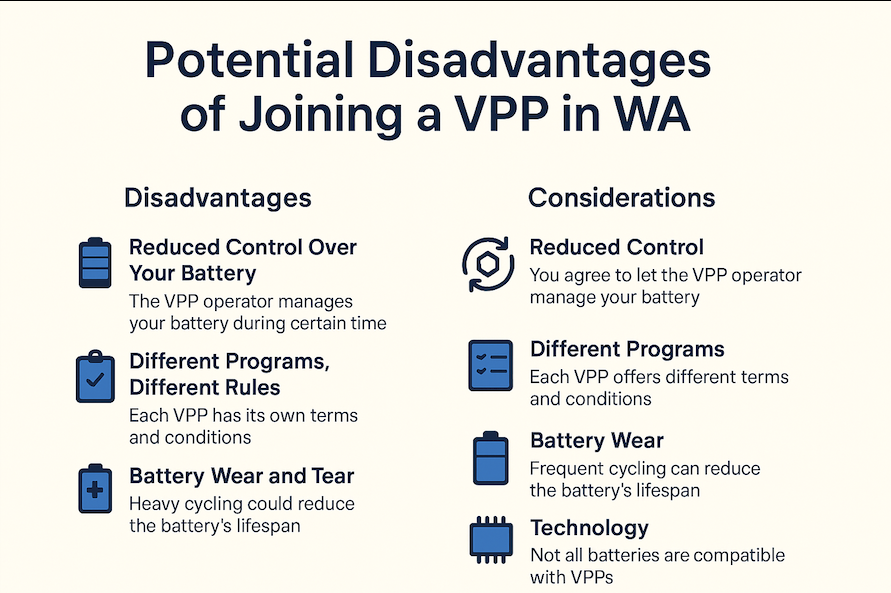
1. Reduced Control Over Your Battery
When you join a VPP, you agree to allow the operator to manage your battery during certain times. This might mean your stored energy is exported to the grid when it’s most valuable for the network, rather than when you personally want to use it. For example, if you’re worried about a power outage and want your battery at full capacity, you may have less flexibility depending on your VPP’s rules.
2. Battery Wear and Tear
Every time your battery is charged or discharged, it undergoes a cycle. Heavy cycling, especially if managed aggressively by a VPP operator, could reduce the battery’s long-term lifespan. While modern lithium-ion batteries are durable, it’s something worth factoring into your payback period.
3. Technology Compatibility
To qualify for the WA Government’s Residential Battery Scheme, your system must be VPP-ready. This limits your choice of batteries and may lock you into certain providers or aggregators. If you already own a system that isn’t compatible, you could face additional upgrade costs.
4. Evolving Market Rules
WA’s energy market is still adapting to the rapid growth of distributed energy. As more households join WA’s VPP, new regulations or changes to incentive structures could alter the benefits. It’s a relatively new space, which means conditions may evolve over the life of your battery.
Final Thoughts
By joining a VPP in WA, you’re not just installing solar and battery—you’re becoming part of a clean energy community that benefits you, your neighbourhood, and the entire grid. With the WA Government’s rebate, no-interest loans, and a proven pilot under its belt, now is a great time to step into a smarter energy future.
That being said its advisable to consider the potential disadvantages before making your decision.
Contact Urban Future
At Urban Future our range of Solar batteries and inverters are VPP ready!
Feel free to check out our product range HERE
For more information or if you have any queries your welcome to contact our friendly staff at Urban Future on (08) 6243 1729
Or flick an email to admin@urbanfuture.com.au
Why Choose Us
New Energy Tech Approved Seller
Urban Future is a New Energy Tech Approved Seller, meaning we follow strict consumer protection standards across advice, installation, and support - giving you confidence every step of the way.
Request a Free Quote
Fill in the form and we will be in touch to schedule a booking.

We offer Finance!
Looking to Finance?
urbanfuture has partnered up with Brighte to help our customers find additional payment solutions for their projects.
Brighte’s Green loans offer a 5.89%pa for energy efficient systems, which is applicable on all solar power and hot water systems we offer.
Just let one of our friendly staff members know if you’re looking to finance, and we’ll work with you to find which solution works best for you.