
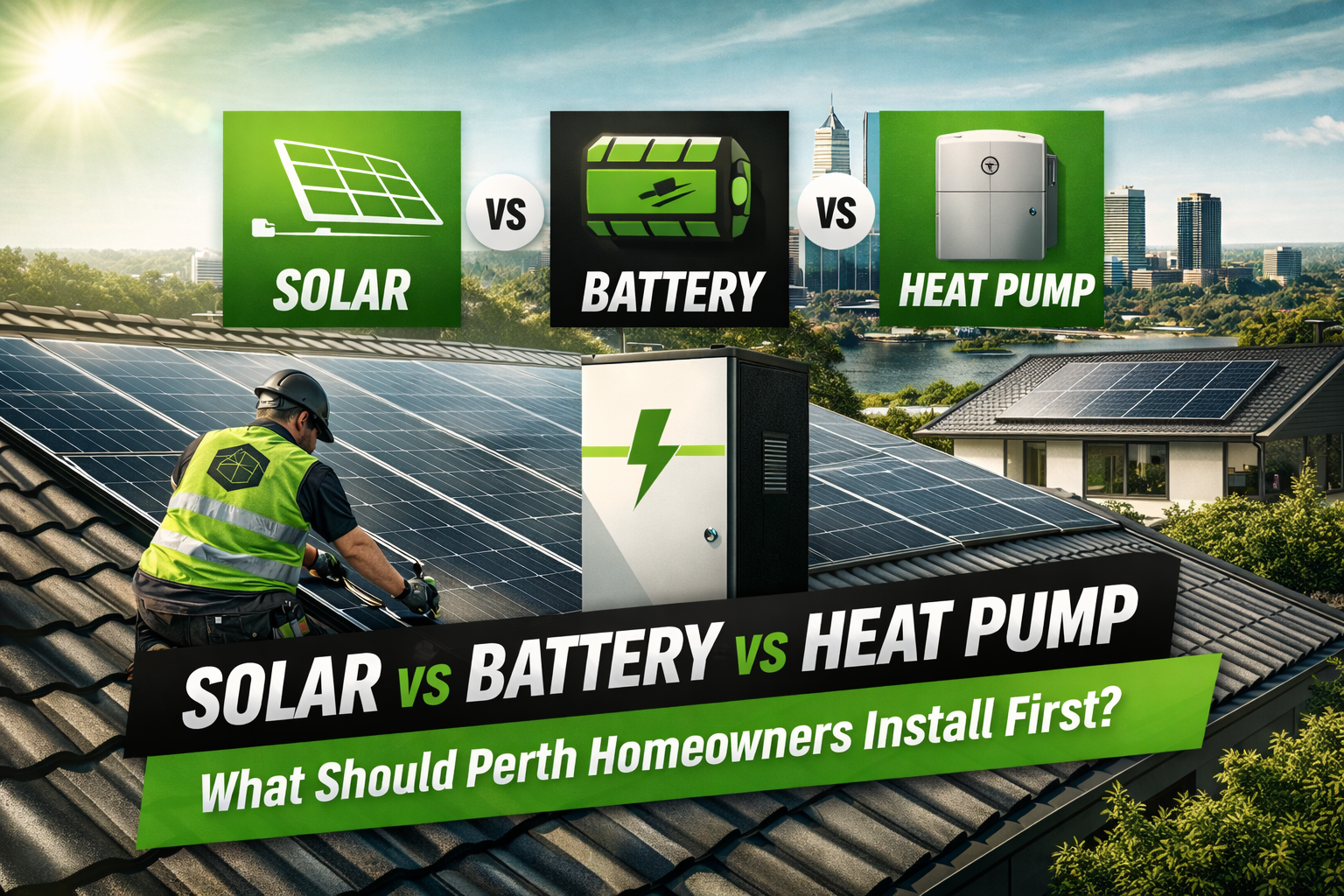
With energy prices rising across Western Australia, more Perth homeowners are investing in solar, batteries, and energy-efficient systems.
But here’s the problem:
👉 Most people install these systems in the wrong order — and it can cost thousands in lost savings.
Understanding the best upgrade sequence is critical if you want to maximise return on investment and reduce your power bills effectively.
Why the Order You Upgrade Matters
Not all energy upgrades deliver the same value at the same time.
The performance and return of each system depends on:
- Your energy usage
- Your home setup
- What systems are already installed
Research shows that system integration and sequencing significantly impact overall energy efficiency and cost savings in residential buildings (International Energy Agency 2021).
Step 1 – Solar (Usually the Best Starting Point)
For most Perth homes, solar is the foundation of an efficient energy system.
Western Australia has some of the highest solar radiation levels globally, making rooftop solar highly effective (Clean Energy Council 2023).
Solar allows you to:
- Generate your own electricity
- Reduce reliance on the grid
- Power other systems (like hot water and batteries)
👉 This is why solar typically delivers the fastest return on investment.
However, solar alone doesn’t solve everything — especially if energy usage isn’t optimised.
Step 2 – Heat Pump Hot Water (The Hidden Winner)
Hot water is one of the largest energy users in Australian homes, often accounting for 15–25% of total household energy consumption (Department of Industry, Science, Energy and Resources 2022).
Heat pump systems are significantly more efficient than traditional electric storage systems because they transfer heat rather than generate it directly.
Research shows heat pumps can reduce energy consumption for water heating by up to 60–75% (International Renewable Energy Agency 2020).
👉 When paired with solar, this becomes extremely powerful:
- Solar powers the heat pump during the day
- You dramatically reduce grid usage
- You maximise solar self-consumption
This is one of the most overlooked upgrades — and one of the highest impact.
Step 3 – Battery Storage (When It Actually Makes Sense)
Batteries are often the most talked-about upgrade — but not always the best first investment.
Battery systems:
- Store excess solar energy
- Reduce reliance on the grid at night
- Provide backup power (in some systems)
However, their financial return depends heavily on:
- Having a properly sized solar system
- Your energy usage patterns
- Electricity pricing structures
Studies show that battery economics improve significantly when paired with optimised solar generation and load management (CSIRO 2023).
👉 Installing a battery too early can limit its value.
The Best Upgrade Order for Different Homes
There is no one-size-fits-all solution — but here’s a general guide:
Families (High Energy Use)
- Solar
- Heat pump hot water
- Battery
👉 Focus: reduce large daily energy demand first
Retirees (Lower Usage)
- Solar
- Battery (optional depending on usage)
👉 Focus: maximising self-consumption
High Energy Homes (Pools, EVs, Large Cooling Loads)
- Solar (larger system)
- Heat pump / electrification upgrades
- Battery
👉 Focus: system integration and future-proofing
The Biggest Mistake Perth Homeowners Make
The most common mistake is simple:
👉 Installing systems in the wrong order.
This leads to:
- Overspending on batteries
- Underutilised solar systems
- Missed efficiency gains
Research highlights that poor system planning reduces overall energy performance and economic return in residential energy systems (International Energy Agency 2021).
The Smarter Way to Upgrade Your Home
Instead of buying individual products, the smarter approach is to design a complete home energy system.
This includes:
- Solar generation
- Efficient appliances (like heat pumps)
- Storage solutions
- Future energy needs
👉 This integrated approach delivers the best long-term outcomes.
Get Your Home Energy System Designed Properly
Most companies sell products.
We design complete home energy systems tailored to your home and lifestyle.
👉 Book Your Free Energy Assessment Today
- Custom upgrade plan
- Bill reduction strategy
- Future-proof system design
👉 Call Now: (08) 6343 1729
Final Thoughts
Perth homeowners are in a unique position to take advantage of solar and energy-efficient technologies.
But success comes down to one key factor:
👉 Installing the right systems, in the right order.
Get it right, and you maximise savings.
Get it wrong, and you leave money on the table.
REFERENCES
Clean Energy Council. 2023. Clean Energy Australia Report 2023.
CSIRO. 2023. Distributed Energy Resources Roadmap.
Department of Industry, Science, Energy and Resources. 2022. Energy Use in Australian Homes.
International Energy Agency. 2021. Net Zero by 2050: A Roadmap for the Global Energy Sector.
International Renewable Energy Agency. 2020. Innovation Outlook: Renewable Energy Integration.
Why Choose Us

New Energy Tech Approved Seller
Urban Future is a New Energy Tech Approved Seller, meaning we follow strict consumer protection standards across advice, installation, and support - giving you confidence every step of the way.
Request a Free Quote
Fill in the form and we will be in touch to schedule a booking.

We offer Finance!
Looking to Finance?
urbanfuture has partnered up with Brighte to help our customers find additional payment solutions for their projects.
Brighte’s Green loans offer a 5.89%pa for energy efficient systems, which is applicable on all solar power and hot water systems we offer.
Just let one of our friendly staff members know if you’re looking to finance, and we’ll work with you to find which solution works best for you.